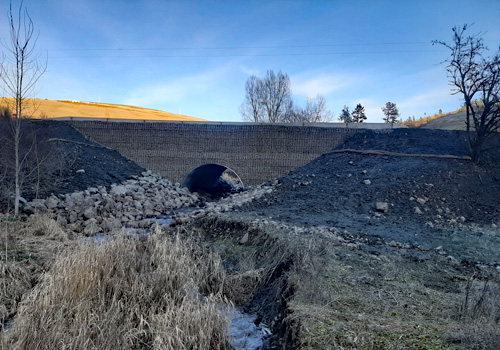
The district has been working on removal of a fish passage barrier on George Grade about 10 miles North of Culdesac, Idaho. 1.67 miles of steelhead (Oncorhynchus mykiss) habitat on George Creek that is crucial for spawning and rearing was blocked by an 8 foot diameter culvert with a 4 foot drop outlet.
Steelhead have been documented at the confluence of George Creek and Cottonwood Creek; just downstream of the blocking culvert. Fish-friendly culverts can open miles of upstream habitat that would otherwise be inaccessible for spawning and survival. While the exact conditions vary by stream, smaller headwater streams tend to stay cooler during the summer—an important factor for fish survival.
Spawning temperatures for steelhead are typically within a narrow range (16°C/60.8°F), and larger downstream sections often exceed this range as they warm in the sun and move away from their groundwater sources. Additionally, larger water bodies expose fish to more predators, especially where woody debris is lacking. By restoring connectivity and access to cooler upstream areas, we improve survival chances for Idaho’s iconic fish species.
The Conservation District is installing a bottomless culvert for this project so that stream can naturally meander. This design preserves the streambed and prevents scouring because the flow erodes the channel more like a natural stream. Roads and low stream flows can disrupt stream connectivity and block fish access to important habitat. It also gives the Conservation District an opportunity to assist with improving old road infrastructure that is at risk for washing out or flooding.
One lane has been opened over the culvert and the road is no longer closed.